
Are AI Summaries Killing Deep Reading? Here's What the Science Says

Read. Mark. Return.
AI summaries are useful. They can help you decide whether a paper deserves your time, orient yourself in an unfamiliar subject, or make a difficult passage easier to enter.
But a summary is not the same as understanding.
That distinction matters more now that AI-generated overviews are becoming part of ordinary search, study, research, and work. The question is not whether summaries are good or bad in isolation. It is what happens when a shortened version quietly replaces the act of reading.
Recent research suggests that the answer is uncomfortable: when AI does too much of the searching, selecting, and synthesizing, people may come away with a clean impression of knowledge without the deeper structure needed to retain, question, and use it.
The shortcut can remove more than time
A 2026 report from PsyPost covered a study published in PNAS Nexus comparing how people learned through standard web search and through AI-generated summaries.
Across seven experiments, participants learned about topics such as gardening and healthy living. Some searched through linked sources. Others received a ChatGPT-style summary or an AI Overview. In some versions of the experiment, both groups had access to the same underlying facts.
The difference was the process.
People who learned from AI summaries spent less time learning and reported learning fewer new things. When they later gave advice, their responses tended to be shorter, less detailed, less original, and more similar to one another. They also felt less ownership of the advice they produced.
This does not mean that every summary causes shallow learning. The researchers themselves note important limitations, including the use of paid participants and hypothetical advice scenarios.
But the pattern is worth noticing.
The summary did not necessarily give people fewer facts. It reduced the work of finding, comparing, and assembling those facts. That work may be inconvenient, but it is also part of how knowledge becomes connected and personally meaningful.
A shortcut is helpful when it removes wasted effort.
It becomes misleading when it removes the effort that creates thought.
Fluency is not proof
AI summaries often feel good to read. They are orderly. They use confident language. They bring several points together in a few paragraphs.
That fluency can create what some researchers and commentators describe as an illusion of analysis: the impression that something has been carefully examined because it has been presented in the form of analysis.
The distinction is subtle.
A summary may tell you what a document appears to say. It may not show how the argument develops, which evidence carries the most weight, where the author changes direction, or what remains uncertain.
Those details are not decoration. They are part of the meaning.
A research paper’s conclusion depends on its method. A policy argument depends on its assumptions. A long interview may contain a useful claim only after several qualifications and reversals. When all of this is compressed into a smooth answer, the result may be easier to consume while becoming harder to inspect.
The University of Bath’s 2026 study on the Dunning–Kruger effect offers a useful parallel, though it was not a study of AI summaries directly.
The researchers argue that the familiar story about incompetent people being especially overconfident may be produced by flawed statistical analysis. When the analysis is corrected, the apparent pattern changes.
The lesson for AI reading is not that the Bath study proves summaries are harmful. It does not.
The lesson is more modest, and perhaps more important: a clear interpretation can be mistaken for the underlying reality. The form of an explanation can make us less curious about how it was produced.
Deep reading is not the same as reading slowly
Deep reading does not require treating every article like a graduate seminar.
Some material only needs a glance. A summary can be entirely appropriate when you are sorting through a crowded inbox, checking whether a paper is relevant, or deciding whether a podcast belongs on your listening list.
The problem begins when triage becomes the destination.
In GeekWire’s “How to read with AI,” Ethan Etzioni makes a related case for using AI as a guide rather than a substitute. Summaries can help you decide where to look. Questions can help you investigate a document. But important claims still need to be checked against the source.
That suggests a more useful division of labor:
- Let AI help you find the shape of a document.
- Let it explain a difficult term where it appears.
- Let it surface possible questions and connections.
- Keep the work of judging, questioning, and interpreting with yourself.
This is not an argument against an AI reading assistant. It is an argument for choosing its role carefully.
Structure before summary
A summary tells you what a piece contains.
Structure helps you see how it is built.
That difference is central to how Omphalis approaches reading comprehension. Instead of reducing an article or paper to a short answer, it lays out the movement of the source: its claims, turns, evidence, definitions, and denser moments.
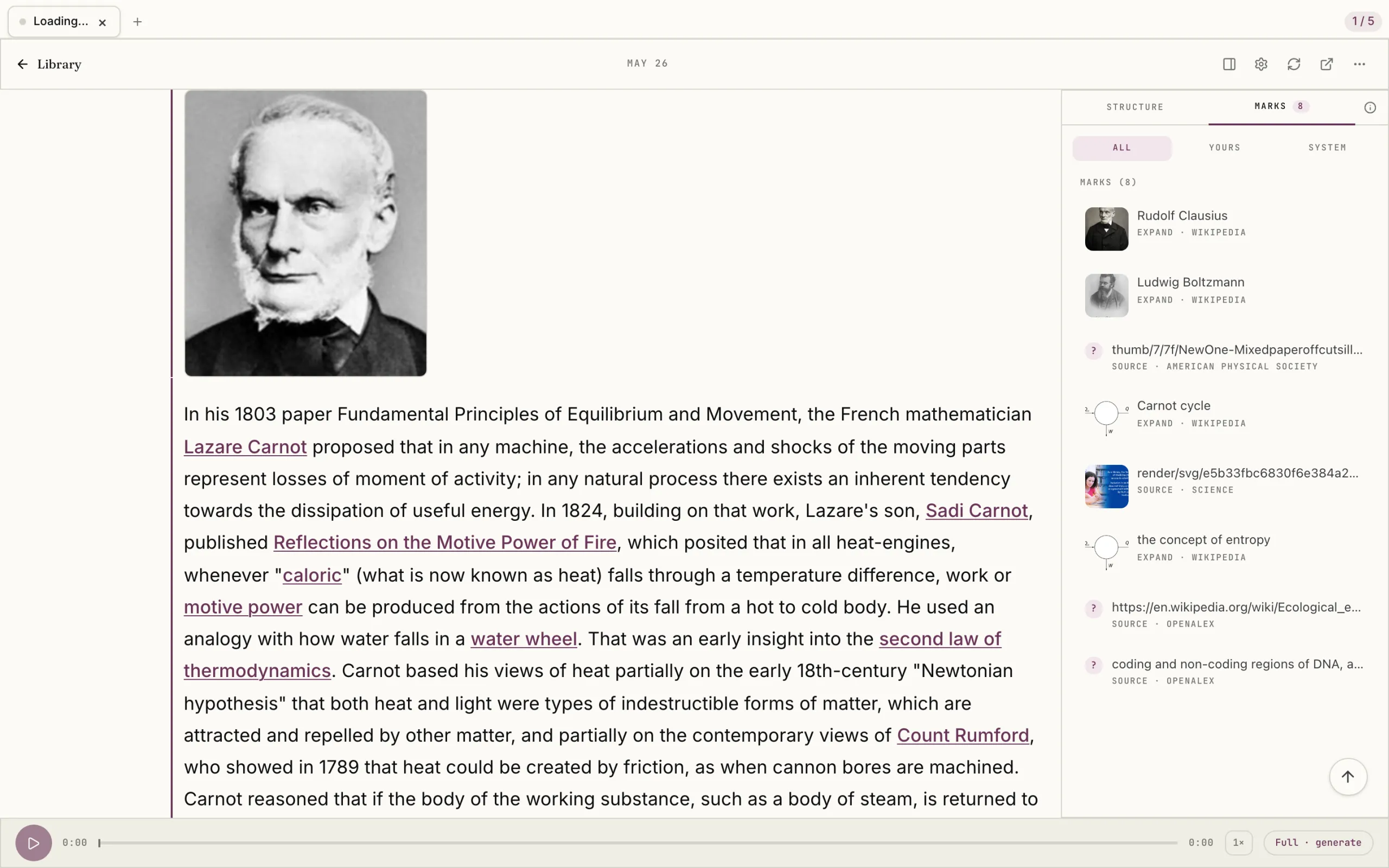
A map of structure does not ask you to skip the document. It gives you bearings before you enter it.
Imagine opening a dense research paper after a long day. You can see where the argument is introduced, where the method becomes important, and where the author qualifies the conclusion. You still read the paper. But you are less likely to lose the thread.
That is a different kind of assistance.
The goal is not less reading. It is easier entry, steadier attention, and a clearer way back.
Use AI during the encounter
Many AI tools are designed for what happens after reading: summarize this article, extract the key points, generate notes.
Those actions can be useful. But comprehension often develops during the encounter itself.
You pause over a definition.
You notice that the evidence does not quite support the claim.
You mark a paragraph because it changes how you understand a question you have been carrying for months.
An AI reading assistant can support those moments without taking them over. It can explain an unfamiliar reference in place. It can help you compare two sections. It can show where a document becomes especially dense. It can let you ask, “What assumption is doing the work here?” and then return you to the passage where that assumption appears.
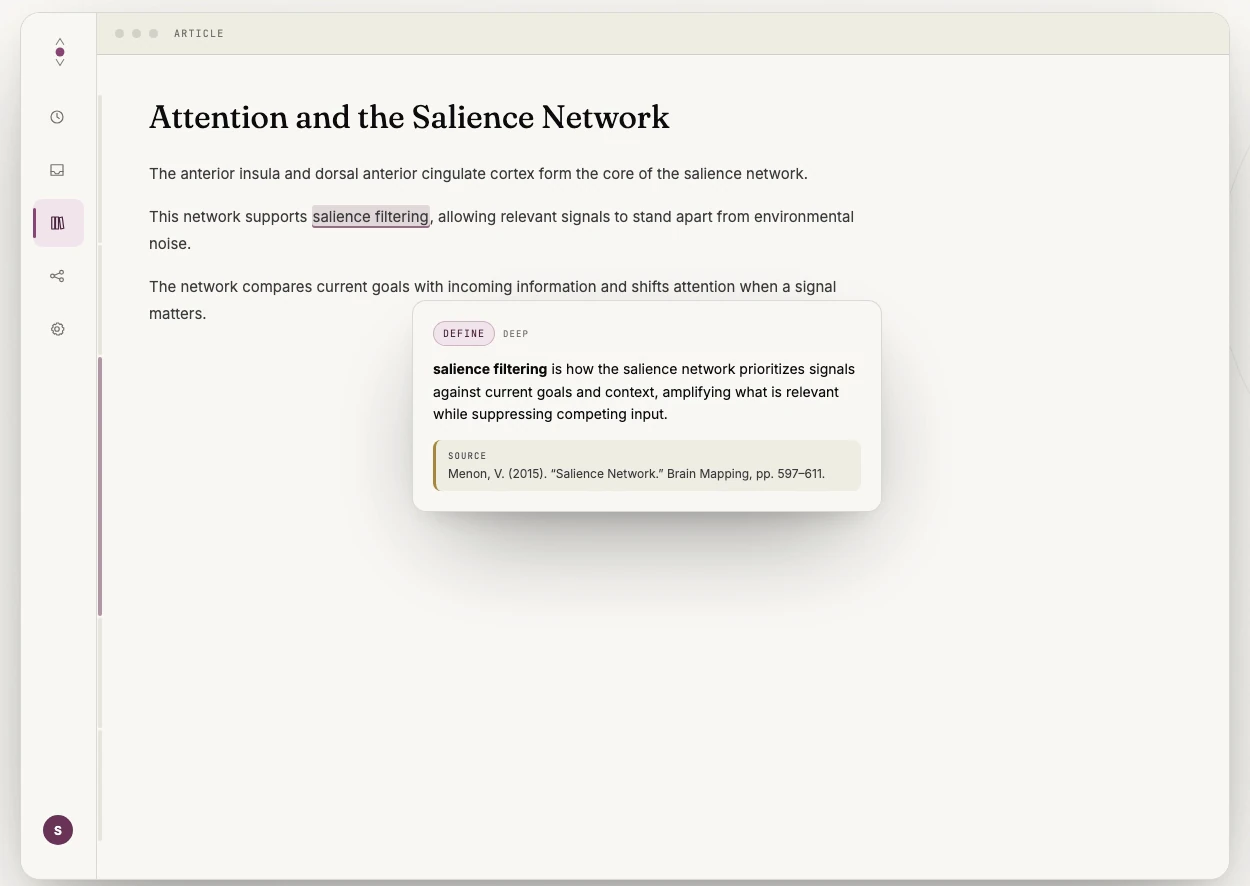
The important thing is that assistance remains close to the source.
A document analysis AI should not only produce an answer about a paper. It should help you inspect the paper. It should make the path between a generated explanation and the original passage easy to follow.
For high-stakes work, verification remains necessary. Check the quote. Open the page. Read the qualification. AI can point toward an answer, but it should not quietly become the authority for what the source means.
Your marks are part of the knowledge
A generic summary represents what a system decided was important.
Your marks represent what you noticed.
Those are not interchangeable.
One reader may mark a definition. Another may mark a contradiction. A researcher may save a limitation for a future literature review. A student may keep a passage because it changes the question they thought they were asking.
The meaning of a mark is personal and contextual. It belongs with the source, the moment, and the reason it mattered.
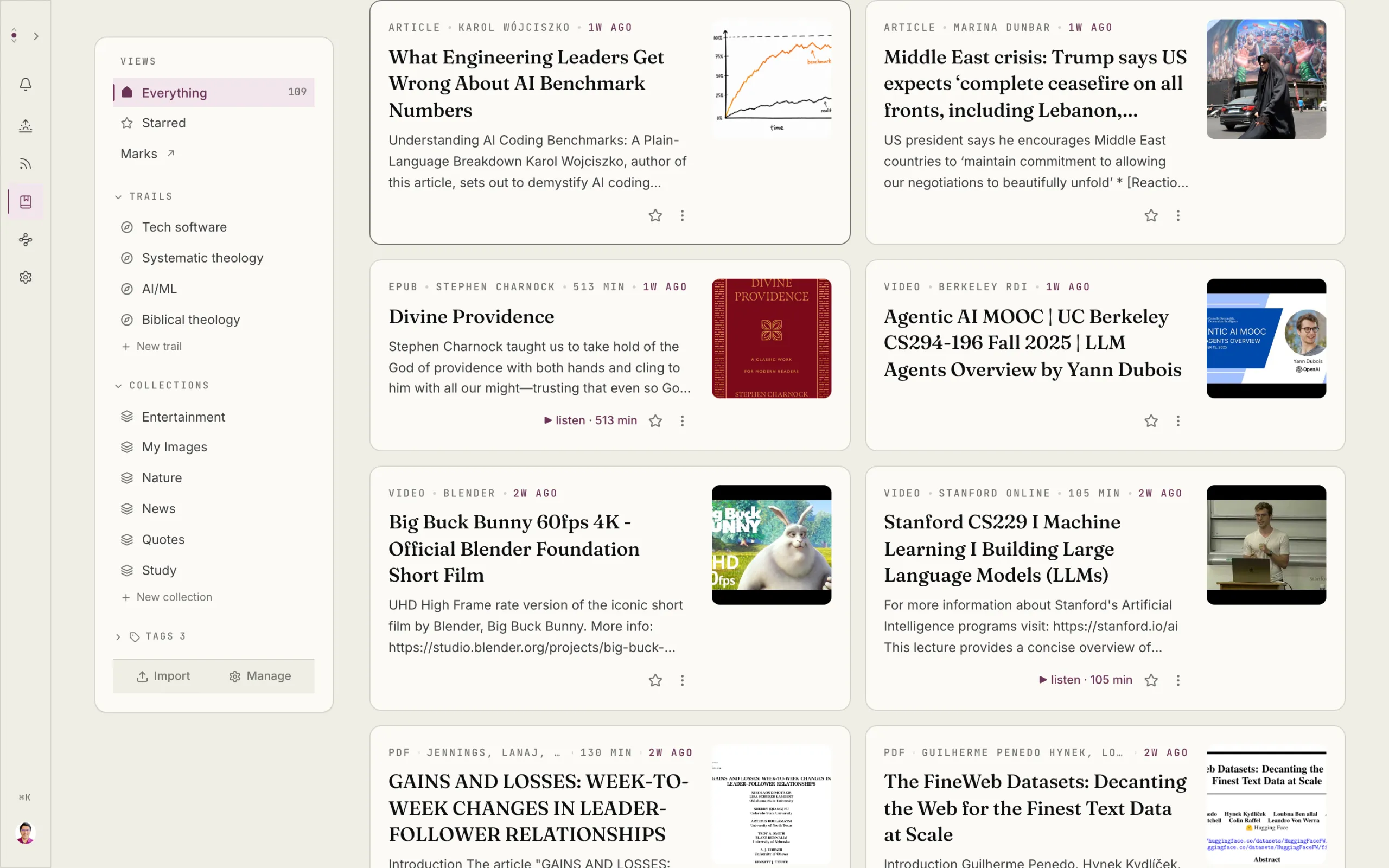
This is why Omphalis treats annotations as first-class data rather than incidental highlights. A marked paragraph can remain connected to the document it came from and to other ideas you chose to keep. Months later, you can return to the passage: not just to a polished sentence generated about it.
That continuity matters.
Understanding is not only having the right answer today. It is being able to recover how you arrived there, what you questioned, and what changed afterward.
A better reading loop
A practical AI-supported reading workflow might look like this:
Orient yourself.
Look at the document’s structure and decide what deserves close attention.Read the source.
Follow the argument. Slow down where the evidence, definitions, or qualifications matter.Ask targeted questions.
Use AI to clarify a passage, identify an assumption, or compare two parts of the text.Mark what matters to you.
Save the claims, questions, tensions, and references you may need again.Return to the source.
Verify important details and keep your own interpretation distinguishable from the system’s explanation.
This loop does not eliminate effort. It protects the right effort.
It moves you from saving to understanding, from fragments to coherence, and from passive consumption to active engagement.
So, are AI summaries killing deep reading?
Not by themselves.
AI summaries become dangerous when they are treated as a replacement for reading, searching, or forming a view. The evidence so far suggests that this pattern can produce shallower knowledge, weaker recall, less originality, and an inflated sense of understanding.
Used with care, summaries can still help. They can act as a threshold, a signpost, or a first orientation.
But the deeper alternative is not simply “read everything manually.” It is to use AI around the act of understanding rather than instead of it.
Let it clean the page.
Let it show the structure.
Let it explain the difficult moment and surface a possible connection.
Then read, mark, question, and decide for yourself.
Omphalis is a content understanding platform built for that kind of work across articles, PDFs, podcasts, and videos. It does not try to tell you that you are finished. It helps you stay with what matters: and find your way back.
A summary can shorten a source. Understanding gives you a way back to it.