A Literature Review Workflow That Doesn't Turn Into a Pile of Tabs

Save less randomly. Read with structure. Mark what matters. Return to the connections.
A literature review rarely becomes difficult because one paper is impossible to read. It becomes difficult because the papers arrive faster than your understanding can settle.
A link goes into a browser tab. A PDF lands in a downloads folder. A useful sentence gets copied into scattered notes. A week later, you remember the general argument but not which paper made it, where the evidence appeared, or why it seemed important at the time.
The result is accumulation without continuity.
A good literature review workflow should help you move from saving sources to understanding them. It should make the original material easier to enter without turning it into a generic summary. It should preserve your own marks, questions, and interpretations so they remain available when you begin to write.
The workflow below follows four movements:
save → read → annotate → connect
Not a replacement for research judgment. A structure for using it.
1. Save with a question in mind
The first step is not collecting everything that looks relevant. It is defining what relevance means for this review.
Before opening a database or search engine, write a working question in one or two sentences. It does not need to be final. It does need to give your search a center.
You might define:
- the population, field, or phenomenon
- the period you are reviewing
- the methods or types of evidence you will include
- the specific problem your review is trying to clarify
- the audience who will use the review
This matters because a literature review is not a catalogue of everything published on a topic. It is a conversation among selected sources.
The Purdue OWL guide to writing a literature review describes the task as collecting key sources and discussing them “in conversation with each other.” That conversation becomes much harder to see when every search result is treated as equally important.
Create one central project space for the review. Your reference manager can remain the source of truth for bibliographic details. A separate reading environment can help you work with the content itself.
For each source, record a small amount of context at the moment you save it:
- Why might this paper matter?
- Where did you find it?
- Is it for screening, possible inclusion, or background?
- What question does it seem to address?
A short note is enough. The point is to preserve the reason for saving the paper before it disappears beneath the next result.
Keep a search record
For a systematic or scoping review, record the database, search terms, filters, date, and number of results. For a narrative review, the record can be lighter, but it still helps you understand how the source set developed.
Keep a list of:
- search terms and synonyms
- important review papers
- papers found through citation chains
- sources you have not yet been able to access
- reasons for excluding a paper
This is not administrative decoration. It protects the boundaries of the review and makes later decisions easier to explain.
2. Read the paper, not only its description
AI search tools and literature databases can help you find promising sources. A literature review AI tool may also help identify recurring terms, related papers, or likely themes.
But discovery is not comprehension.
A title, abstract, or generated summary can tell you whether a paper deserves attention. It cannot replace reading the paper when you need to understand the study’s argument, method, limits, and evidence.
This is where the reading environment matters.
A research paper often arrives in a form that makes reading harder than it needs to be: two columns, broken headings, references interrupting the flow, figures separated from the claims they support, and terminology that requires constant searching.
Omphalis is designed to make that material easier to enter while keeping the source intact. Its research paper workflow cleans and restructures a PDF, lays out the paper’s sections, explains difficult terms in place, and lets you read or listen while keeping your place.
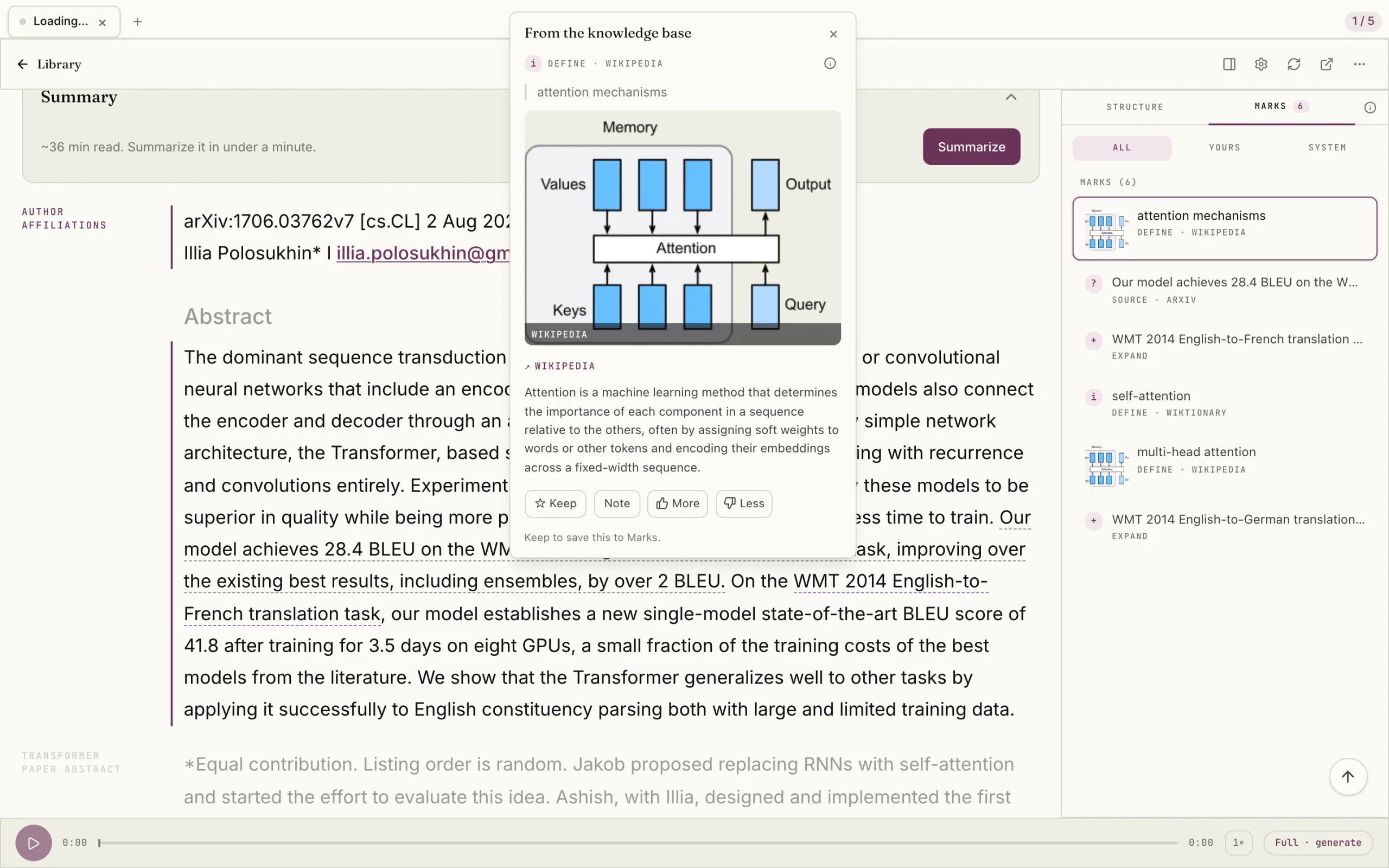
The structural view is particularly useful during a first serious pass. It can show where the argument turns, where the dense sections begin, and how the paper is assembled.
That does not mean the system decides what the paper means for you. It gives you a map before you begin walking.
Use two reading passes
A simple two-pass approach keeps the review from becoming an endless sequence of half-read papers.
Pass one: triage.
Read the title and abstract. Scan the introduction and conclusion. Check the method, population, or evidence. Then assign one of three states:
- include
- maybe
- exclude
Record the reason. “Wrong population” or “outside date range” is more useful than a vague sense that the paper is not quite right.
Pass two: deep reading.
For included and promising papers, read the full text. Look for the parts that a summary often compresses away:
- how the research question is framed
- what the method makes visible
- what the results actually support
- which limitations the authors acknowledge
- where the paper agrees or disagrees with other work
Difficulty is not always a reason to exclude a paper. Sometimes the difficult section is where the most important qualification lives.
3. Annotate while the thought is present
Do not wait until the end of your reading session to write notes.
The useful observation is often temporary. You notice that a definition differs from one in another paper. You see a limitation that changes how you interpret the result. You think of a possible theme for your review.
Mark it while it is still connected to the passage.
A useful annotation system can be small. You might use four types:
- important : a central claim or finding
- question : something unclear or unresolved
- method : a detail about design, data, or approach
- use : a passage that may support your own argument
Add a sentence in your own words where needed. If you copy a passage verbatim, keep quotation marks and the page or section reference. This helps prevent accidental misattribution later.
The difference between a highlight and a useful annotation is recoverability.
A highlight says, “I noticed this.”
A durable annotation says, “I noticed this because…”
Omphalis treats the reader’s marks as first-class information. What you marked, questioned, or found useful remains attached to the source, rather than disappearing into a general AI summary or an unsearchable note pile.
That distinction matters when you return to the paper two weeks later. You do not only need the paper. You need the path your attention took through it.
“If you read the papers first, and only afterwards start writing the review, you will need a very good memory to remember who wrote what, and what your impressions and associations were while reading each single paper.” : Marco Pautasso, Ten Simple Rules for Writing a Literature Review
The practical lesson is simple: reading and writing should not be completely separate stages. Your early notes can become the first outline of the review.

4. Extract knowledge without flattening the source
A knowledge extraction tool can help you turn long papers into a more workable set of observations.
For each included source, create a compact extraction record:
| Field | What to capture |
|---|---|
| Research question | What is the paper trying to find out? |
| Approach | What method, theory, or dataset does it use? |
| Main finding | What does the evidence show? |
| Limitation | What should a careful reader not conclude? |
| Relevance | How does it relate to your review question? |
| Passage | Which section supports your note? |
| Connection | Which other source does it resemble or challenge? |
AI can assist with the first pass. It may identify sections, extract candidate findings, or suggest recurring themes across a group of papers.
Treat those outputs as working material, not verified evidence.
Check important claims against the original paper. Read the surrounding passage. Confirm whether the method and qualification have been preserved. A tool can organize language without understanding the full stakes of a result.
This is one of the boundaries of a research workflow tool: it can surface, arrange, and suggest. It should not become the authority that decides what the evidence means.
Your interpretation remains central.
5. Connect marks across sources
A literature review becomes a review when the sources begin to speak to one another.
Once you have read and annotated several papers, move from individual source notes to a synthesis matrix. Each row can represent a paper. Each column can represent a dimension that matters to your question.
Depending on your field, those dimensions might include:
- theory
- method
- population
- context
- finding
- limitation
- disagreement
- open question
Then look across the rows.
Where do several papers use the same concept differently? Where do methods produce different results? Which limitations recur? Which claim appears often but rests on a narrow evidence base? Where does a newer paper revise an older assumption?
These are the beginnings of themes.
Organize the review around those themes rather than writing one paragraph per author. The Purdue OWL guidance recommends thematic, methodological, chronological, or theoretical structures depending on the purpose of the review. Whatever structure you choose, avoid turning chronology into a list. Focus on patterns, turning points, and debates.
Omphalis supports this stage through contextual connection. Your marked passages can become a personal layer across the papers you have read. A concept marked in one source can lead you back to a related insight in another.
This is not an automatic map of the field. It is a map of what you have chosen to notice.
That difference protects the ownership of meaning.
6. Write from the connections
Before drafting, write a short statement for each major theme:
- What is the shared question?
- What does the literature agree on?
- Where does it divide?
- What remains uncertain?
- Why does this matter for the research question?
A strong synthesis paragraph often follows a simple pattern:
- make a claim about the theme
- bring several sources into relation
- explain the agreement, contrast, or development
- identify the implication or remaining gap
This is different from summarizing each paper in isolation.
The review should help your reader understand the shape of the conversation. It should show what has been established, what is debated, and what still needs careful investigation.
“Reviewing the literature is not stamp collecting.” : Marco Pautasso, PLOS Computational Biology
The phrase is useful because it names the central risk. A larger source count does not necessarily produce a stronger review. A smaller, well-understood set of sources may reveal more.
A practical weekly rhythm
You can adapt the workflow to a course paper, dissertation chapter, or larger review:
Monday : search and save
Run searches, follow citation chains, and add candidates to your central library.
Tuesday : triage
Screen titles and abstracts. Apply your inclusion and exclusion criteria.
Wednesday and Thursday : read and annotate
Work through selected papers in focused sessions. Mark claims, methods, questions, and useful passages.
Friday : extract and connect
Update the synthesis matrix. Compare annotations across papers. Name emerging themes.
Weekend : write and verify
Draft from the themes. Reopen the original passages behind important claims. Adjust language where the evidence is more limited than the first draft suggested.
This rhythm separates collection from comprehension without making them unrelated. Every stage prepares the next one.
The goal is a way back
A literature review workflow should not help you collect more tabs. It should help you return to what mattered.
Use a reference manager for citation control. Use databases and search tools for discovery. Use AI carefully for orientation and extraction. Use your own annotations to preserve judgment.
Omphalis fits into the reading layer: a place to clean, structure, read, listen, mark, and connect long-form research material. It does not replace the paper, your method, or your responsibility to verify the evidence.
It helps turn scattered sources into a readable path.
Not a pile of tabs.
A way back to the argument.
Try Omphalis on a research paper or start with the research workflow.